Sunday, January 22, 2012

Reading during the day

As I am sure you are aware, the children are involved in a variety of reading activities everyday.  We have a poem of the week that we read in every morning, a quiet reading time where children can read individually or with a friend, and almost everyday I read  aloud from a chapter book.  


Here are some examples of the things we are reading during our Map Unit:


The first week there was a riddle to solve:


I have streets but no pavement, 

I have cities but no buildings, 

I have forests but no trees, 

I have rivers yet no water. 

What am I?
(answer: a map)


I read My Father's Dragon by Ruth Stiles Gannett to the children.  The story includes a beautiful maps of the islands the boy travels to.  

The children really enjoyed following the adventures of Elmer Elevator.  If you are looking for books to read at home with your child, you may consider reading the other 2 books in the trilogy.

The second week's  poem helped the children learn the names of the continents:

To learn the seven continents

Think of the letter A,

And when you're down to only one

An E will save the day.

There's Africa, Antarctica,
 Australia, Asia, too;

The oceans run between them

With their waters deep and blue.

There are also two Americas--
North and South, you see.

Now we're coming to the end.

Europe starts with E!


I also started a new chapter book: Paddle-to- the-Sea by Holling Clancy Holling.  In this story, a Canadian boy carves a small wooden canoe that he sends off down a river, hoping it will make it's way to the sea.  We will be looking at maps of the Great Lakes as we track the canoes journey.

Tuesday, January 17, 2012

Winter Walk

We had winter weather for our "Winter Nature Walk with Faye".
 Each child received a map of the County Farm Park.  Together we decided on a destination and then used the maps to find the chosen location.  

As we trekked through the snow the damp weather took a toll on our maps but we still made it to our destination.  On the way we found evidence of animals in the woods.  There were tracks in the snow and a branch a rabbit had  nibbled on.


It was a great walk but it was also nice to get back to school and warm up with some hot chocolate and cider.

Saturday, January 7, 2012

Exploring Maps

Maps of the world, maps of the country, maps of the city...
We often pull down the World or United States maps for a reference in discussions, but this month our focus will be on maps.  We will be exploring all different types of maps.


What about a map of your room, map of your heart, map of a dog...
These are some of the maps in the book we will be reading by Sara Fanelli.


Personally, I love looking a maps.  I hope by the end of the month the children will gain an appreciation for how much you can learn from maps.  Maybe we will even find some cartographers in our midsts. 


Snacks schedule

It's time for the next rounds of snacks.  Mark your calendar for the week your family brings snacks for the class.


Remember to keep the snacks healthy and nut free.  There is a morning and afternoon snack. Our class has 12.  Also, there are 2 children in the class who can not have dairy.


Jan. 9-13..Andrés
Jan. 18-20...Andrew
Jan. 23-27...Viola
Jan. 30-Feb. 3...Niko
Feb. 6-10...Arwyn
Feb. 13-17...Gabe
Feb. 23-March 2...Oliver
March 5-9...Noah
March 12-16...Dominic
March 19-23...Kaden
March 26-30...Kit
April 9-13...Varvara
April 23-27...Andrés
April 30-May 4...Andrew
May 7-11...Viola
May 14-17...Niko
May 21-25...Arwyn
May 29-June 1...Gabe
June 4-7...Oliver

Tuesday, December 27, 2011

Thank you

...to all the Summers-Knoll families who contributed to the generous gift certificate from Zingerman's.   


Also thank you for all the kind notes and sweet treats.  What a way to end 2011; thanks for your show of appreciation.

Sunday, December 18, 2011

Bones


This fall, the children  started learning the names of the bones in our body with Dr. George.  


This week, they learned some of the reasons we have bones: to hold us up, to help us move, and to make blood.  


The spine is very important because it protects the spinal cord. 
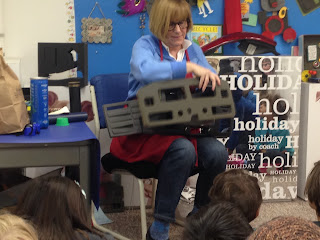
In order to learn more about the spine, we went to visit Dr. Rose at Rose Chiropractic.  Dr. Rose showed us a model of the spine.  We could see how the nerves come from all over the body to the spinal cord.  He told us how  ligaments  hold the bones in place and showed us the cushion between each vertebra called a disc.  Dr. Rose also talked to us about keeping the spine healthy.  It is important to make sure you are not spending a lot of time with your back in the "C" shape.  Many people sit in this shape when they are working at a computer or reading in bed.  As we were leaving Dr. Rose taught us how to walk really straight by pretending we have a string pulling our head up to the ceiling.
The children had excellent manners at the office and told Dr. Rose about all the things they had learned about the body.  He was very impressed.  When we left, he told me, I had a great class, which I could not dispute.


A big thank you to Dr. Rose for letting us come to visit.

The Body

The last couple weeks, we have been learning about the body.  We started with each child writing down one or two parts of the body to learn more about.
Here is the consensus:
skin
brain
eyes
bones
cells


I went to the library and collected many books about the human body.

The epidermis was a logical place to start. The children already knew that skin: "holds in all your parts" and that "it keeps your blood in so you don't bleed till you die".   From a Bill Nye DVD we gained more information about skin from a scientific point of view.  We also listened to an adaptation of Rudyard Kipling's "How the Rhinoceros Got His Skin", for a fictional perspective on the subject.  


After exploring the skin, I added digestion to the list of systems we would learn about.  I have found that the children love this topic because it ends in the popular subject of "poop".  
Digestion starts with the teeth so we made tooth puppets.  Then the food travels down your throat to the esophagus.  At this point the children learned that there is another tube called the trachea that brings air to your lungs.  So that food doesn't go down the wrong passage way, there is a special flap called the epiglottis that keeps food from going in your lungs.  The children loved all these scientific terms.  


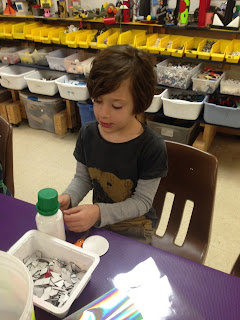
Next, on to the stomach, where the food is mixed with digestive juices.  The children made mock esophagus's and stomachs to take home and do a quick experiment with water and a cracker to simulate what happens in to food in the stomach.  The next day we talked about what happened and then talked about the final stages of digestion that happen in the small and large intestines.