Tuesday, May 24, 2011

Nesting

Cardinal
Robin

We are very lucky to have two birds nesting right by our school.  


There is a cardinal in the bush next to the playground door.  She does not seem to be bothered by the children playing around her, however, she is camera shy.  


I tried several times to take her picture and she would fly off.  Finally, I was able to get a quick shot of her on her nest.  It will be interesting to see how the parents react to us once the babies are born.  


In the pine tree, right outside our classroom door, a robin has made a nest.  She is on a low branch so we can watch her through the window.  We are anxiously waiting for her eggs to hatch so we can watch the baby birds being fed.

Monday, May 23, 2011

Reflecting

 I spent this weekend reflecting and writing about the journey the children in my class have taken this year.  


Reflections Night was a perfect start to this muse.  I watched children who entered the class in September with a combination of trepidation, anxiety, and excitement, standing and performing in front of a room filled with adults.  On stage, each child's personality was apparent, as well as their ability to come together as a group with a common goal.  They demonstrated confidence and maturity as they performed in front of an adoring audience of family and friends.  What an amazing night!

Thursday, May 19, 2011

Poetry Book

As you may have read in an earlier blog posting, during poetry month Christine and Jeff, Juna's parents, came in and did a poetry workshop with the class.

Now, the poems have been "published".  Jeff put all the children's poems in an anthology, A Bestiary by the students of Elaine's class.


The children were thrilled to see their poems in print.  Thank you Jeff.

Wednesday, May 18, 2011

Story Problems

Math books are just a small part of the math hour.  Each child spends about 10-15 minutes working in their workbooks.  The first part of the math time we work on a wide variety of hands-on and group activities.  During past couple months we have been working on solving word problems with partners or in small groups.

This is how it works: I tell a story and ask a question about the story.  In small groups the children try to figure out how to solve the problem and try to come up with an answer.

Here is an example of one a story I told this week:

In a house there lived a man, a woman, a child, a bird, and a dog.  One day the child wanted to know how many legs there were in the house.

The class was divided into 4 group and given the task of figuring out the answer for the child.  They had a paper and pencil.  They could figure out the answer using any technique they wanted.

-One group made a drawing of the people and animals and then counted the legs.
-Another group made lines to represent the legs and counted their lines.
-Two children used skip counting by 2's, stating the the dog had 4 legs so that was 2, 2's.
-The fourth group wrote a number problem to determine the answer:
2+2+2+2+4=12

With this assignment the process critical.  The children must work as a team, collaborate, and present what they did to others.  All the children see first hand that there is not just one way to get to the right answer.

Sunday, May 15, 2011

Prairies

We have started a study of American Prairies.  The children have been getting a historical perspective of prairie life through books such as Elsie's Bird and Prairie School.  They have also learned about modern prairie restoration projects in  Butterfly Count, a fictional account of a young girl's experience helping in a reconstruction project, and in The Prairie Builders, which follows scientist's efforts to rebuild the Neal Smith National Wildlife Refuge.


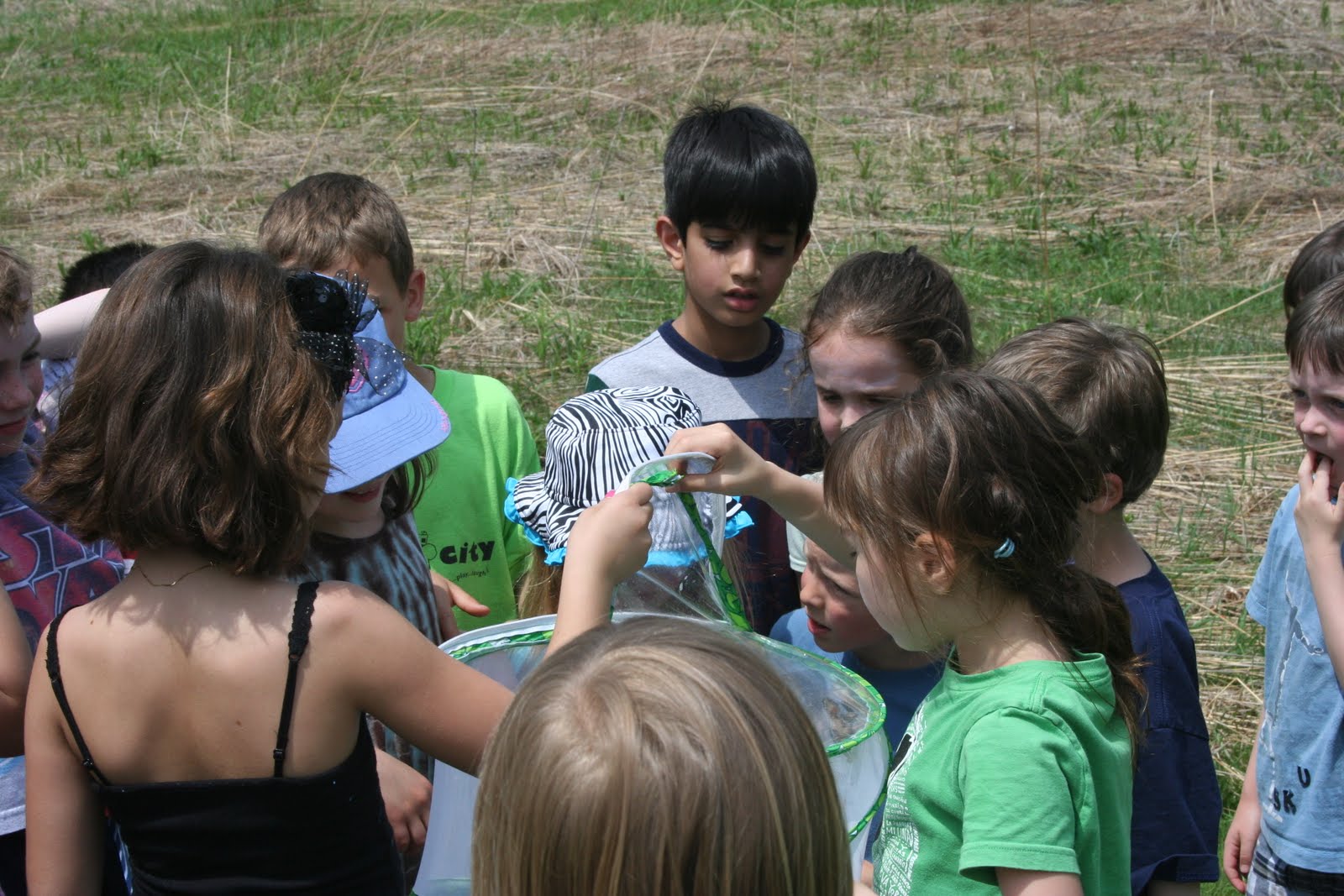
Friday, we walked through the Botanical Garden trail to the Marilyn Bland Prairie.  At this time of year there were not many signs of life on the prairie.  The fields were filled with stubble from last years grasses and flowers.  Susan's class brought 10 Painted Lady butterflies to release on the prairie. The butterflies hatched from chrysalises earlier this week.  Standing on the hillside we watched as the Painted Ladies joined a few other butterflies who have already returned to the area.  


 After a long hot walk back through the woods we enjoyed sitting under a tree for a quick snack before heading back to school.

Sunday, May 1, 2011

Scientists at Work


Don't underestimate the power of play.  During pretend play children come to understand the world around them.  It is a place where they can try out ideas, roles, and activities in a fun, safe manner.  One minute you can be a dragon, the next a mother, and later a builder.  


On Friday morning, the children were scientists.  They used test tubes and eye droppers to mix colored water.  Maybe not the most sophisticated experiment but the important part was that they felt like scientists.  In the afternoon, they got to look through microscopes at the cells of an onion skin.  


I can be what I imagine myself to be.

More kitchen science

Good observational skills and being able to draw conclusions from what is observed are essential tools for a scientist. Over the past weeks, the children have been practicing these skill while observing chemical reactions and carrying out simple experiments. 

One experiment was to find out the conditions yeast grows best in.  First, they tried water temperature: boiling water, room temperature water, and ice water.  As the children predicted, the yeast bubbled most with the room temperature water.  Then, they took 3 containers of water at room temperature and added yeast.  Next, they added salt to one, sugar to another, and the 3rd was left plain.  Probably, based on personal experience, most of the children predicted the yeast would like sugar best and it did.


The best part of this experiment was putting our knowledge of yeast to the test.  On Thursday, we made bread.