Monday, December 20, 2010

Bitter sweet


Thursday we had to say goodbye to Ella Keppo.  As most of you have heard, the Keppo family will spend the rest of the school year on sabbatical in British Columbia.

We will miss Ella and her family but know they are going to have an amazing experience in the mountains of Canada.
We will stay in touch with Ella through letters and emails and look forward to seeing her back at Summers-Knoll next September.

Poem and Project

Snow, Aldo
By Kate DiCamillo


Once, I was in New York.
in Central Park, and I saw
an old man in a black overcoat walking
a black dog.  This was springtime
and the trees were still
bare and the sky was
gray and low and it began, suddenly,
to snow:
big fat flakes
that twirled and landed on the black of the man's overcoat and
the black dog's fur.  The dog
lifted his face and stared
up at the sky.  The man looked
up, too.  "Snow Aldo," he said to the dog,
"snow."  And he laughed.
The dog looked
at him and wagged his tail.

If I was in charge of making
snow globes, this is what I would put inside:
the old man in the black overcoat,
the black dog,
two friends with their faces turned up to the sky
as if they were receiving a blessing,
as if they were being blessed together
by something
as simple as snow
in March.

As part of our author study this month, the children read Kate DiCamillo's poem, Snow Aldo.   They had the opportunity to make their own snow globes.

Snow Globes

Team work


Children need many and varied opportunities to work together.  Learning to work as part of a group does not come automatically, it takes practice.


Here is a recent example of such an assignment.  The children were divided up into groups, given a recipe, a bowl, and ingredients and told to make play dough.  There was one hitch.  The children were given  1/3 cup measuring cups and the recipe called for several full cups of ingredients. We discussed that it takes three 1/3 cups to make a cup and then the children were on their own.   I stepped back and let the children work out how they were going to accomplish the task.
Each group had different solutions for dividing up the tasks and taking turns. They conferred with each other about adaptations  to the recipe to make the play dough the right consistency. In the end both groups successfully had a hunk of play dough for each child to take home.

Beautiful Shirts

Karen thank you for initiating, planning and executing this creative project. The children intently used evergreen branches and pine cones and fingers to create their one-of-a-kind shirts.   
Every shirt was unique, colorful and festive. 

Thursday, December 9, 2010

Math books coming home

The children are very excited to finish their first math books.  Friday afternoon they will bring home their books.  As you look at the books, you might think,  "this looks too easy for my child".  Please realize that this is only a part of the math curriculum.  At this point in the year, all the children are working on the same 3 or 4 pages.  We generally spend about 10 minutes a day doing math books.  (Some children spend more time because they like to color the pictures.)

Most of the concepts introduced are very familiar for the children.  The difficult part of the process is following directions. We read and talk about the instructions together.  Inevitably, right after we go through the instructions of what to do, I will hear cries of, "what are we supposed to do on this page?".  I remind myself daily, this is an important part of the process and each day it will get easier.
You might be wondering what else goes on during math, and how does it relate to the math books?


Here is an example from this week. The last few units in the books have to do with same concept, more and less.  Before working in their books I introduced the math symbols that go along with these concepts, =, >, and <.  The children had cards with the signs on them.  They made two piles of blocks and put the correct sign in between.  We played the "number line" game. I tell the children I am thinking of a number is greater than 0 and less than 50.  They make guesses to narrow the choices till someone guess the correct number. 

How many pennies to balance a bear?
How long is this in inches
and in centimeters
Here are some more examples from past units:


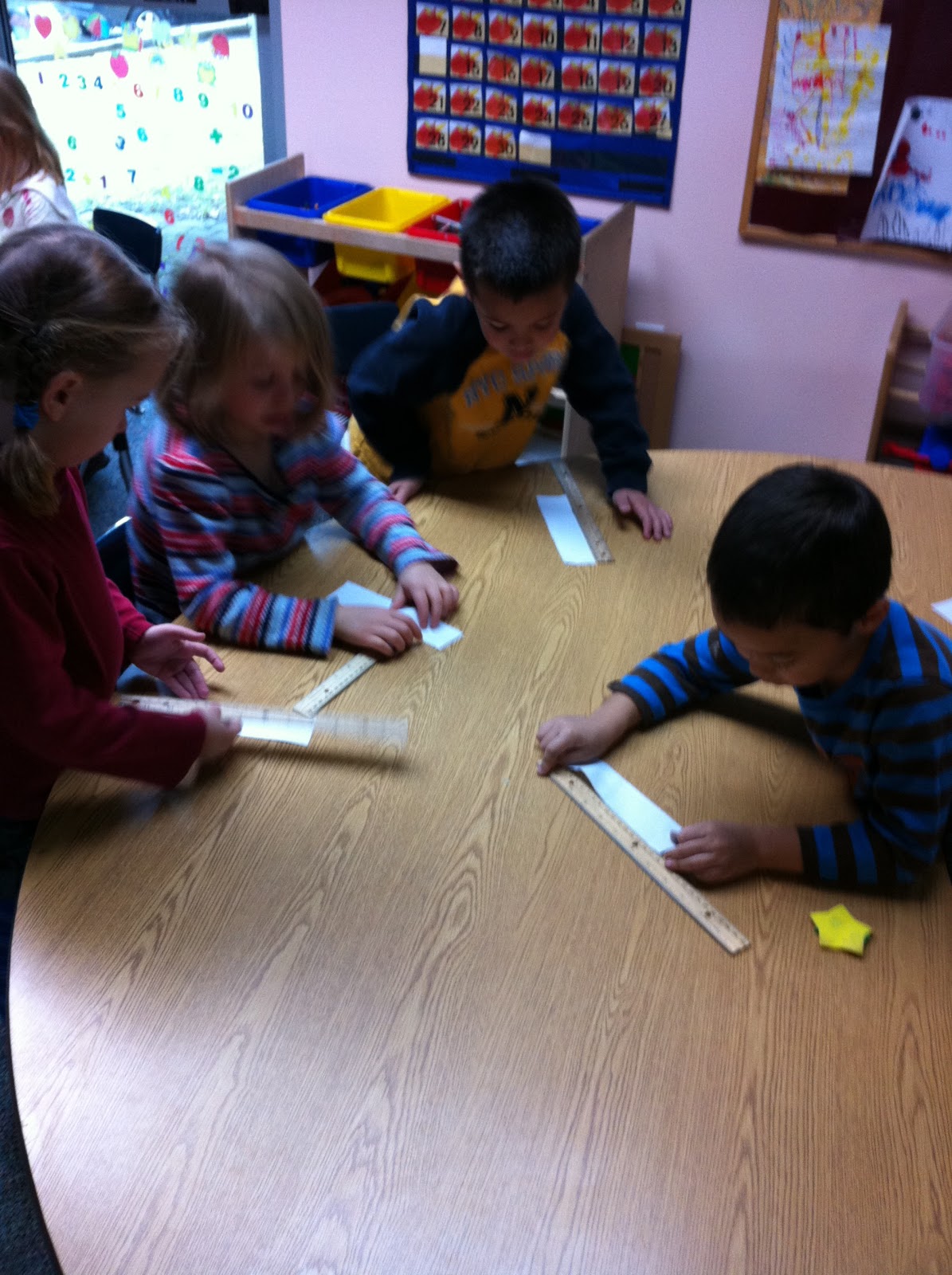
During the measuring units, the children used various measuring tools: rulers, yard/meter sticks, tape measures, balance scales, and weight scale.
When we were talking about capacity the children worked in groups.  Each child got a turn finding a receptacle.  Everyone made a guess on the capacity of the container and then figured out the actual capacity.  The results were recorded on a chart.


Joanna came into the room during this activity and whispered, "they are being very precise".  Precision in this activity was not as important as working together as a team and practice counting and writing down results. 


Last but not least, reading and literature is included any chance it can fit.  For example, when we were looking at shapes, the children took turns reading Shel Silverstein's poem, Shapes.  

Monday, December 6, 2010

Children reading


Many parents have asked me questions  about the books children are bringing home to read.  I thought I would spend a minute to answer a few of the questions publicly in case other people were wondering the same things.  Since most of the children are still beginning readers, the information is particularly geared to them.


FAQ:
"My child is only interested in reading the book a couple of times.  Do we need to keep the book all week?


No.  The reason I have the books go home for a week is two fold. 
One is to alleviate guilt.  I know everyone has busy lives and I don't want people to feel bad if they don't have time to read one night or if their child is not in the mood to read.  By giving a week, I hope the experience can be relaxed and enjoyable.
Second, some children love to read the books many times so I want to let them have that opportunity. 
However all children are different, if there are children who want to get a new book every day or two, that is perfectly alright.


"My child loves to "read" the books but is not really reading, he has just memorized the story."


Don't worry.  The most important thing at this stage is that the children feels and acts like a reader.  As they "read" more they will start to recognize more words and patterns of words, which will increase their fluency.


"What else can we do at home?


-Read with and to your child every day. 
-When your child is reading to you ask them questions to help them focus on the words.  For example, "What letter does worm start with?"  "Which word says monster?"  
-Ask them questions to make sure they are comprehending what they are reading.  "Who were the characters in this story?"  "Why do you think the dad got stuck in the snow?"
 -Play word games, like rhyming words: at, pat, rat,cat...this will help children start seeing the patterns in words.
-Words are everywhere.  Read signs while you are driving to school,  labels in the grocery store, menus at restaurants but, make it fun.  Don't feel you constantly have to make everything a lesson or it will become a chore and your child's enthusiasm with wane. 


-This last suggestion comes from a parent.  Miina told me that other day that they have started playing a "game" of writing sentences from the book on a white board and then seeing if Ella can figure it out what they say without the aid of the pictures.  


Please don't hesitate to ask if you have other questions about reading or anything else.


Saturday, December 4, 2010

Birds in Flight

I was probably more excited then the children to go "behind the scenes" at the museum on Thursday, but the trip was better than I could have ever imagined.  The success of the trip was primarily due to the amazing presentation by Janet, a curator at the museum.  From the minute we walked into the room the children's eyes were wide, taking in the incredible collection of treasures before them.

Janet showed us bird bones and skeletons.  We got to see that bird bones are hollow, to make them lighter for flight, and how a bird's wing has the some of the same bones as a human: humerus, radius and ulna.  Birds even have an elbow, but look at all the other bones they have in their wings.  


She pointed out the wishbone on birds that expands and contracts as the wing goes back and forth, and that the breast bone on a bird  has a part that sticks out to help hold their large breast muscles that are needed in flight.  If you eat chicken or turkey for dinner in the near future, your child is going to want to find the wish bone and try to make a wish, so you better buy a whole bird, not just parts.                                               

We saw how wings have large feathers for flying and smaller soft downy feathers to help birds stay warm.  Janet let us see and feel various bird's wings.  We saw how birds have different shaped wings depending on where they fly.  For example, the end of an owl's wing is blunt so it can fly easily around the trees in the forest.  An albatross has long thin wings so it can glide long distances over the water.

It was almost inconceivable to see all the rows of drawers and think that there were over 100,000 specimens inside.  It was a thrill to stand next to a seven foot ostrich skeleton and an eagle's wing from Panama that was taller than any of the children.


These are just a few of the facts we learned about birds and flight.  I am sure your child will be happy to tell you more about how birds breathe and how many toes an ostrich has...